
May Newsletter 2026
Save the date for Reading Triathlon Volunteering – 13 September
As the current winner of Large Event of the Year for the South Central Region, expectations are high for Tri2O to put on another fantastic Reading Triathlon.
Please keep Sunday 13 September free to help out in some capacity on event day. There’ll be a sign up system circulated soon and don’t worry if you’re already committed for the Sunday, there’ll be roles on earlier days to prep the site 😊
We all benefit from the proceeds of this event – it’s how we keep membership fees down, swim session costs competitive and fund social events. So please do support your Club and this local event with your time, enthusiasm, and smiles 😁
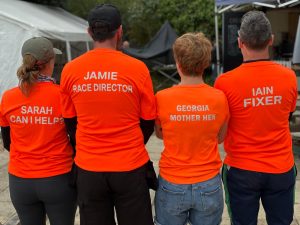
Jamie, Georgia, Iain and Sarah
🧡🧡🧡🧡
Membership Update
Please join me in welcoming our new members to the club:
Alexander Pepper
Dominic Birchett
Rachel Clement
Harry Smith
Mark Jones
Rob Duncan
Dinesh Tomar
Philip Brady
Laura Nagi
James Hooper
Angela Massey
Karolina Fankidejska
Jonny Kirton
Lily Kitto
Christopher Ash
Rian Kelly (welcome back!)
Milly Pelmore
Jo Mace
I hope you will enjoy training with us!
For anyone that wants to get the most out of the club and would like a call to talk this through – please let me know. Please join the WhatsApp community to keep up to date with what is going on.
Coach Corner
Fuelling effectively according to your training
In a recent Purple Patch Fitness podcast Matt Dixon interviewed Megan Foley, registered dietitian for Fuelin, and the episode provided some really helpful advice and guidance on the fundamentals of adapting your intake according to your training. I’d really recommend a listen here: https://youtu.be/VVmraAEwTYg, but here are a few takeaway points (as well as my little additions!):
- Periodise your nutrition and fuelling in the same way that you might periodise your training – it changes through the year as well as from one session to another.
- Build the foundations first with a high quality diet; good quality protein, veggies & fibre, healthy fats & wholegrain carbs.
- On top of that (not instead!), add your extra carbs to fuel all your training sessions – and e.g. higher intensity, longer sessions need even more. This is really important.
- Remember that performance does not equal “race weight”(nobody ever was weighed at the end of a triathlon to determine who wins!), and a focus on race weight rather than fuelling your training is likely to be detrimental to performance.
- Trying to restrict intake to focus on an arbitrary number on the scales, particularly if you’re ramping up training, is counter-productive.
- Your weight might be one of many many factors (sleep, rest, training load, life stressors) that may influence your performance – but it should not be your main focus. Trying to reduce weight by restricting calories in race season is generally a bad idea.
- You can never give 100% if you only give yourself 85% (I loved this quote!); and if you are under-fuelled this will negatively impact your sleep, motivation, recovery, risk of injuries and illness.
- Fuel to allow you to do the training, not as a reward for doing it. I see this a lot, with athletes talking about “earning” their food. It’s not a healthy attitude and can be a sign of a more dysfunctional relationship with food. It comes from many years of negative and punitive messaging in the media & fitness world regarding intake and is quite damaging.
- Megan talks about her 5 R’s to optimise recovery and so adaptation to training:
- Replenish muscle glycogen (that’s your body’s preferred fuel, so take carbs ASAP after training)
- Repair muscle damage (protein – less time-critical BUT easier to get it all at the same time from a point of view of establishing routine & a reliable habit of intake after training
- Rehydrating (in addition to during – you can rarely take in enough during a session)
- Reinforce your immune system (includes all of the above)
- REST! (sleep, downtime)
- Training, nutrition and sleep are closely related and not independent of each other. So if you’re thinking “There’s no point in tackling my nutrition if I’m not getting more than 6 hours sleep”, this is not the case: improving your nutrition & fuelling may well have a beneficial effect on your sleep, etc.
- Calorie deficit, Training, and Insufficient sleep are all stressors on the body (not to mention life/work stress!), and too much stress in a combination of these areas will have a negative effect on your health, let alone performance.
- Train your gut and practise your planned racing fuelling during training. Remember that longer = more carbs, and higher intensity = more carbs. The higher the intensity, the more important it is that the carbs are easily digestible, because the harder your muscles are working, the more your blood supply needs to be diverted away from your gut to support your muscles. For very low intensity, food is what your body likes best.
Do join the Food & Fuel WhatsApp chat if anyone wants to discuss further!
Happy fuelling team,
Georgia
PS This little article I’ve written is in no way an advertisement, recommendation or endorsement of Fuelin!
PPS Most cake is a really good source of carbs. You’re welcome.
Georgia Jackson
Head Coach
TVT & Tri2O Social 16th June
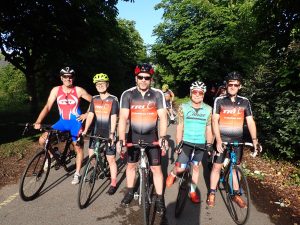
We’re meeting up with our friends from TVT for a fun, relaxed social where you can connect with new people through the sports we all love! 🏊🚴🏃
You are welcome to take part in one, two or all three activities – it’s completely up to you. The only bit we REALLY want to see you at is the food! We’ve arranged for paella to be served after our swimming cycling and running 🥘
Everything this evening will be at a relaxed, social pace. This is all about having fun – no pressure or racing, just a great evening with great people ☀️
Here’s the plan:
Lake Swim: From 5pm onwards. Swim as much or as little as you like, there’s no set distance and it’s self-guided (generously supported by TVT/Tri2O, no need to book via NOWCA).
20km Bike Ride: Starts at 18:30. We’ll ride in friendly, chatty groups of around 6 people. Just bring your good vibes and be ready to go on time!
1 or 2 mile Run/Walk: Starts at 19:40. Whether you fancy a gentle run, a run/walk or something in between, we’ve got supportive groups for all paces.
Paella Party: From 20:00–20:15. Delicious fresh paella made on-site while you relax and chat. Please bring your own drinks, soft or alcoholic, whatever you like.
All we ask is a small contribution of £10 a ticket to the paella fund to help cover the cost of the food.
Head over to TeamApp where you can see more details of the event, purchase a ticket and select your paella option and disciplines you’d like to participate in.
We can’t wait to see you there!
Imo Jackson
Social Secretary
Reflections of a Volunteer Pacer
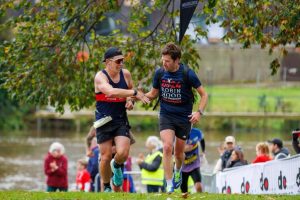
My First Ever Standard Distance Triathlon
Written by Paul Harwood
My first ever standard distance triathlon with a lake swim – Dorney Lake. Up at 5am, family in tow for support. Excitement levels high. Anxiety levels even higher.
Things started perfectly, by being unable to work the zip on my wetsuit. Heart rate already hovering around 100 bpm before I’d even reached the water. Eventually I got sorted and shuffled nervously toward the swim start, trying to look like somebody who absolutely knew what they were doing.
Standing by the lake, I spotted Ellie on the mic from my son Jacob’s tri club (Reading Rascals), which helped settle the nerves slightly. But unlike the coached Tri20 sessions, there was no gentle acclimatisation here. No easing yourself in. No calm warm-up. It was simply: get in and race.
The cold hit instantly.
Within seconds I had that horrible panic-breathing. Short, shallow breaths. No rhythm. No calm. Just survival mode, swimmers all around and it felt chaotic.
I couldn’t get comfortable. Every time I breathed to the left, I seemed to drift left. Breathe right, drift right. I couldn’t see the buoy in the distance.
How exactly am I getting out of here alive?
Panic was starting to creep in, so I switched to breaststroke for a minute just to regroup, breathe, and reset.
Slowly, things improved when I reached the first buoy. Then the second. Somehow, I found myself heading back toward the boathouse on the home leg, overtook a few other swimmers. I swallowed what felt like half the lake after mistiming a breath, but by then I knew I was going to make it.
Thirty-four minutes after starting, I emerged from the water very much alive and running toward T1.
1500 metres done. My longest swim ever.
A huge thank you to Georgia and Jennie for the swim coaching. When I first turned up back in November, 40 metres was about my limit before needing to stop. To now complete a full open-water standard-distance swim felt massive.
T1 was fun. Couldn’t get my socks on. Put my helmet on before I was fully out of the wetsuit. I might as well have had a picnic. Jacob was laughing at me from the sidelines, rightly so, and has already promised to coach me through transition skills before the next race.
To make things even smoother, I’d left the bike in the wrong gear for the mount line… which happened to be uphill.
Still, once rolling, things finally started to come together. Straight onto the aero bars and into the fun part. The bike leg ended up being a real positive. I averaged just over 20mph and managed to stay aero (ish) for most of the ride, albeit with a bit of a stiff neck.
Bike split: 1 hour 8 minutes.
T2 brought fresh chaos. I nearly fell over attempting to run in cleats with jelly-like legs. Then wasted time queueing for the toilet before giving up and running away. To top it off, I somehow got disoriented trying to find the run exit. Better preparation needed next time. Rookie errors everywhere.
But once things settled down in the run, I found a rhythm and held a decent pace, for me anyway. I did have to make an emergency porta-loo wee stop around 2.5km in, losing another 30 seconds or so.
Run split: 47 minutes.
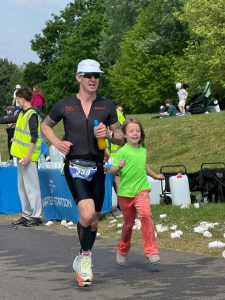
Heading toward the finish line, my daughter joining in the fun – see picture.
After crossing the line and finally reuniting with my family, it was smiles all round. Later that day, I checked the results:
2hrs 36 mins 21 seconds, and 6th out of 16 in my age group.
For a first attempt, I’ll absolutely take that. Chuffed to bits.
Looking forward to the next coached lake session ahead of my next event in early June.
Social Media Corner
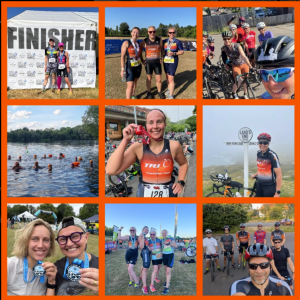
Follow us on Facebook | Twitter | Instagram for the latest updates!
We would love to hear from you
We would love to hear from you, particularly if you have taken on a new challenge or are new to triathlon. If you would like to be included in the next newsletter, please send your contribution to info@tri2o.club.